At IntaVal we have developed a framework for addressing inevitable gaps appearing in IP strategy.
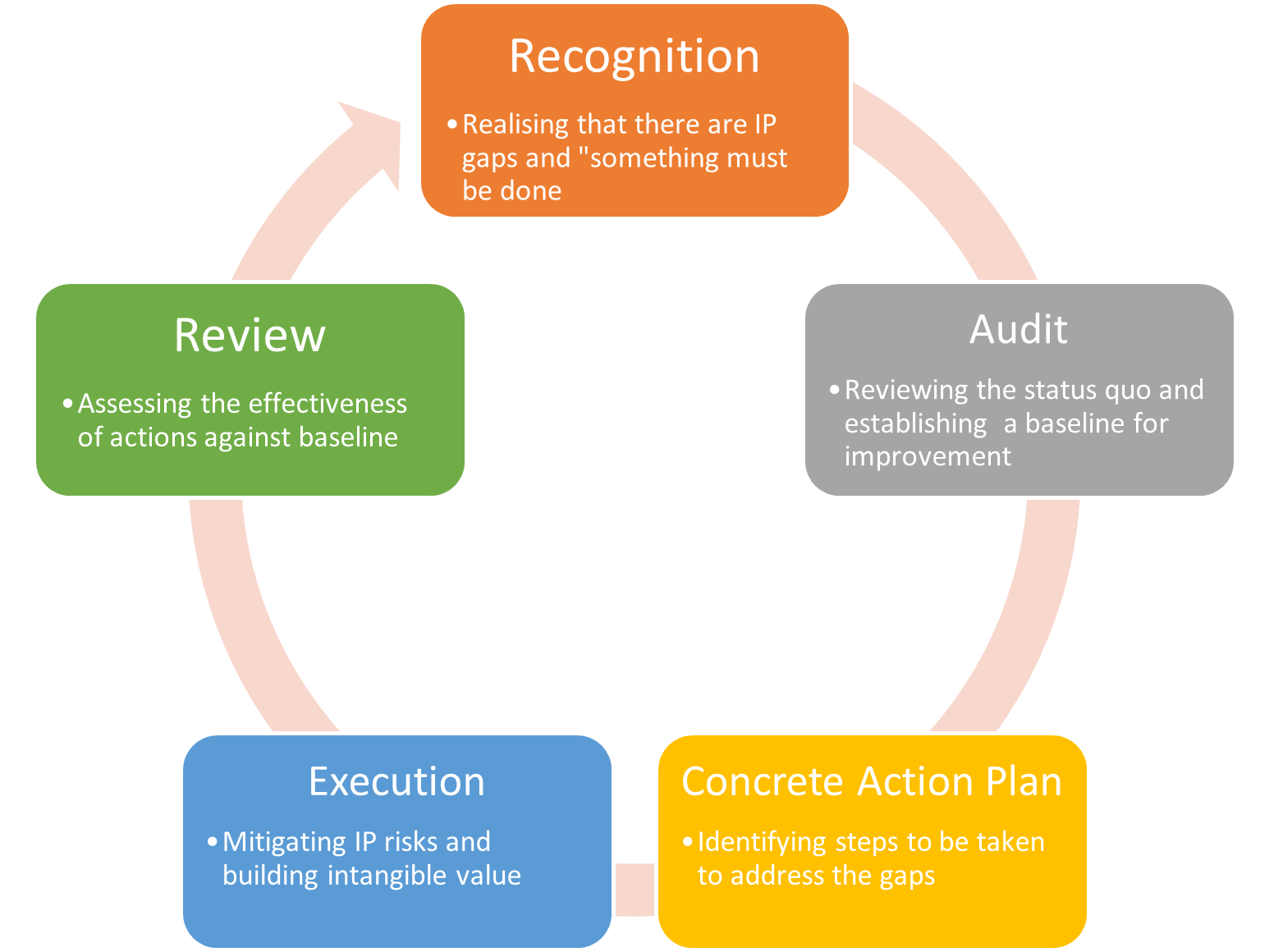
The 5 steps for implementing IP strategy are:
- Recognition – realising that there are IP gaps and “something” must be done
- Audit – reviewing the status quo and establishing a baseline for improvement
- Concrete action plan – Identifying steps to be taken to address intangible gaps
- Execution – mitigating IP risks and building intangible value
- Review – assessing effectiveness of actions against baseline
Recognition
The first step is for management to recognise that there is a potential IP gap and that “something” needs to be done. This can begin in the background as a gnawing concern for management that grows gradually until it cannot be ignored.
Alternatively, the recognition can be forced on companies in response to external pressure, such as:
- demands from investors to tighten up on IP protection
- upcoming due diligence in an acquisition
- preparation for crucial discussions with powerful IP-savvy customers
- increased level of competitive activity by rivals
- accusations of infringement of third-party intellectual property.
Audit
A broad intellectual capital audit will cover intangible assets under the headings of human capital (covering competencies and key skills), relational capital (for example customer and supply chain relationships) and structural capital (including trade secrets and formal intellectual property).
The audit follows a structure that examines assets, contracts, ownership, risks and governance. This audit will identify the firm’s strengths and highlight weaknesses and potential threats. The results of the audit will suggest areas to focus on in a concrete action plan and will also provide a baseline from which to measure improvements.
Concrete action plan
For technology firms, the concrete action plan tends to flow naturally from the audit. Typically, the quickest wins will be in the areas of trade secret protection and invention discovery leading to patenting activity.
Trade secrets
The firm will usually have accumulated valuable knowhow and will already follow general disciplines for protection of confidential information. This should be codified in a well-articulated trade secret protection policy. Trade secrets exist without the need for registration. In law, there are 3 characteristics of trade secrets, namely:
- they are not generally known
- they are of commercial value because they are secret
- reasonable steps were taken to protect the secrecy.
To avail of protection under the 2016 European Trade Secrets Directive and other laws, the firm will have to maintain evidence of all three characteristics of their trade secrets, namely that secrets were not generally known, were valuable and that the firm took actives steps to protect them. One step of the concrete action plan is to identify and classify the firm’s trade secrets. For each of the identified trade secrets, the firm must assemble evidence to support the three characteristics listed above.
Patents
Patents are a route to recognising and protecting valuable inventions. This will be achieved through the following process:
- invention mining – identifying inventions that the firm has created that could be candidates for patent applications
- invention disclosure – capturing the details of each invention on a separate invention disclosure form, which becomes a written record that forms the basis for subsequent patent applications
- initial patentability search – reviewing each invention to assess its suitability as patentable subject matter, comparing it with the current state of the art and identifying any novel features
- patent drafting – if any invention is considered potentially patentable, it will be drafted in a format suitable for submission to the relevant patent office
- patent application filing – filing of the patent application with the appropriate national or international patent office.
Other forms of intellectual property
While this short article focuses mainly on trade secrets and patents, a good IP strategy will surround patents and trade secrets with other forms of intellectual property, such as copyrights and trademarks. This will provide a robust, holistic approach to protecting valuable intangible assets.
Execution
After recognition, audit and creation of a concrete action plan, execution should be easy. Right?
Wrong!
Typically, the in-house person charged with implementing the concrete action plan will be the CTO. Alternatively, in an inventor-led firm, it may be the founder/CEO. When the CTO takes responsibility, the process tends to get derailed by the existing culture. This is because breakneck development continues to pull the CTO away from execution of an IP action plan. After a long time of IP being optional, day-to-day demands will continue to have a higher priority.
The solution to this dilemma is to allocate someone who reports to the CTO as the person with pivotal responsibility. If invention disclosures are being created, that person should have 3 characteristics:
- the ability to write well,
- an excellent understanding of the technology and
- trusted access to the CTO for rapid decisions.
Execution around trade secret protection usually yields some pleasant surprises. As the team builds the catalogue of trade secrets, previously-invisible intangible assets are identified and made visible, thereby contributing to the accumulation of intangible value.
Review
When a logical RACER process is followed, the review will assess the effectiveness of execution against the baseline established in the audit. The RACER process is an iterative learning environment. These activities create a higher level of awareness among employees about the value of their ideas.
As the inventors deal with questions during the patent drafting process, they will find their IP awareness increasing. Active participation in this process will enhance the IP sophistication of everybody involved. This will lead to alertness to further opportunities to reduce IP risks and enhance intangible value.
A one-time process or a cycle?
A project to enhance IP strength often starts out as a one-time process beginning with Recognition and ending with Review, according to the diagram below:
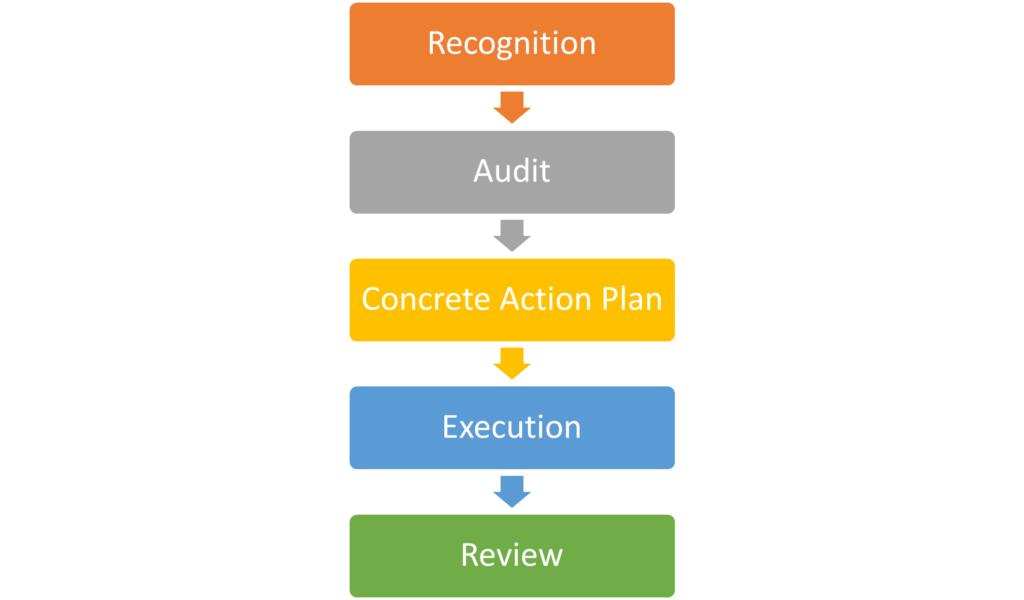
In a dynamic, innovative firm, this linear process will address IP gaps that initiated the project. Furthermore, during the process, the team will move up the learning curve in understanding intangible value. As they experience the feedback process inherent in invention mining, creating invention disclosures, answering questionnaires and assisting in drafting patent applications, they become more sophisticated in the patenting process. As a result, the quality of subsequent patent applications improves.
The IP enhancement project raises awareness of IP value and alertness to further possibilities. Additionally, if there is a clear increase in enterprise value, there is an economic incentive to repeat the process and extract further value.
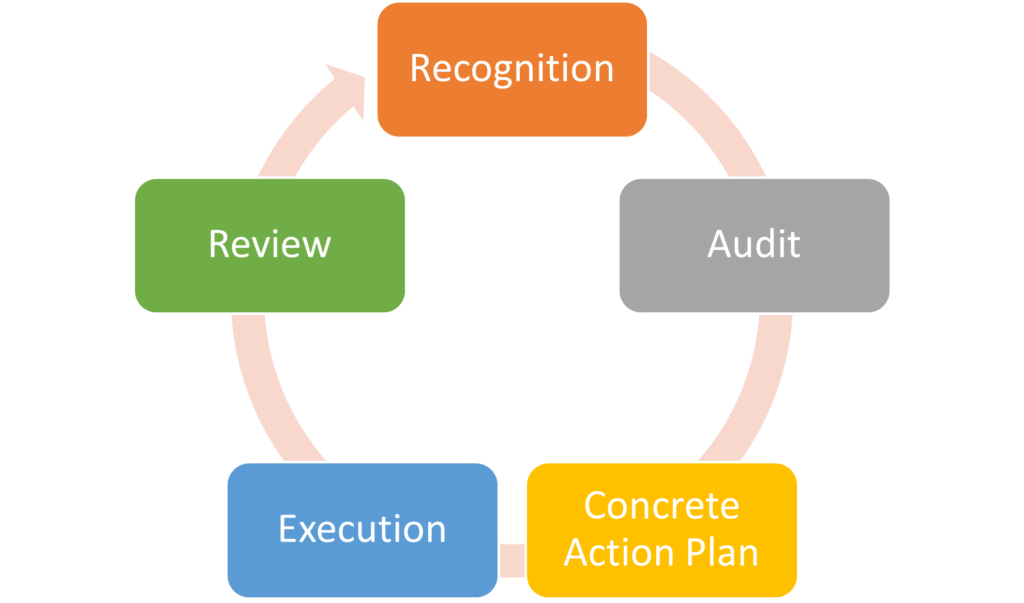
So, the one-time RACER (recognition, audit, concrete action plan, execution review) process leads to a higher awareness of possibilities for further improvement in intangible value. This awareness feeds into recognition of other opportunities and the one-time racer process can become a loop as in the diagram below.
Additional benefits of a RACER intangible value enhancement program
The potential return on investment in intangible value enhancement is clear. In addition to developing a process for boosting intangible strength and mitigating potential IP risks, there are potential financial upsides. RACER can be incorporated into a methodology to identify, classify and capitalise intangibles in accordance with existing accounting procedures and existing International Accounting Standards.
As the value of IP becomes more evident to the firm, it also becomes a way to recognise the contribution of employees and make them feel that their involvement is valued. This can further serve as an example to other employees and an incentive for them to also contribute ideas to advance innovation.
If you want to go deeper on a specific question, you can send an email to coach@intaval.com.
If you would like a specific topic covered, please leave a comment. We read all comments and usually reply within 24 hours.
Raymond Hegarty is an IP strategist, author and speaker. He is an IP coach to CEOs and CFOs of high-growth technology and life science companies.
He is the author of three bestselling books on IP strategy and has spoken to tens of thousands of people on topics of innovation and intellectual property. IAM Magazine has recognised him as one of the world’s top 300 IP strategists every year for the last 10 years.
He is the CEO of IntaVal, a leading global IP strategy consultancy.