Are you planning another round of financing or preparing for a big exit?
Often it starts on the same track.
The ultimate destination may be different from what you expected at the start.
Imagine you are talking with investors about raising funds to bring you to the next stage. They like the company a lot. In fact, they love it so much that they tell you that they want to acquire it.
Or while you are out fundraising in the market, a large strategic buyer approaches you to say they would like to acquire your company.
Whether it is for another funding round or an exit, you negotiate pricing and terms. They make an offer.
Time to celebrate!
Don’t pop the champagne yet!
There’s many a slip ‘twixt cup and lip.
“There’s many a slip ‘twixt cup and lip” sounds like a quaint British proverb, but its wisdom goes back more than 2,200 years to ancient Greece.
Another way of saying it is: “Don’t count your chickens before they are hatched.”

Take NOTHING for granted!
Even when you have an offer in hand, something bad can happen before you close the deal.
Reality check – it can take much longer
Despite what you hear in sanitised stories of successful business transactions, it can take a long time between receiving the offer and closing the deal. Even when the term sheet has a limit of 90 days, the process can often take 9 months or more.
And a big part of that time is due diligence.
What is due diligence?
Due diligence is a process of prudent investigation that an investor undertakes before making an investment. For a technology company, the process typically involves 5 elements – financial due diligence, technology due diligence, market due diligence, management due diligence and legal due diligence.
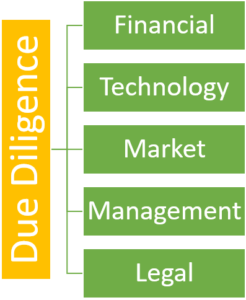
It is logical to probe these categories.
Any investor will want to know the financial situation before they put in money. Your pitch talked about the great solution, the market opportunity and the sparkling management team. The investors want to validate this by performing due diligence on the technology, the market and management. Legal due diligence is necessary because the investors want to know what assets the company owns and what risks could be involved.
So, due diligence should be straightforward
In theory, yes. You know your business. You were honest in your pitch. The investors wouldn’t be interested in your company if it was not so brilliant, would they?
Ideally the due diligence is just to confirm what everybody knows already.
What could slow it down?
Let’s look at each of the categories. If you have prepared well, some elements may go smoothly:
- Financial due diligence – your CFO has everything in order, there are no surprises. An experienced CFO is prepared for the due diligence.
- Technology due diligence – if you are a disruptive startup, you may know more about the technology than anyone else in the world.
- Market due diligence – this is where your assumptions about the market will be tested. Do you know what your competitors are doing? If you have been through robust pitch preparations, you probably have most of the answers.
- Management due diligence – you have assembled the best team to tackle the challenges. You have been through challenges together. You know how they perform under pressure and how well prepared they are to take the business to the next level.
The one area that might trip you up could be the legal due diligence. This is a thorough examination of your company’s assets and risks. This area of investigation has grown in complexity in recent years.
If your company’s value is almost entirely intangible (let’s say 90%), then your assets will be largely invisible. It also follows that 90% of the risks will be invisible.
You could face uncomfortable, unexpected questions.
This trend has been evolving for decades
Investors are asking more pointed questions.
Different questions from what they used to ask. The scope has expanded from simple legal verifications to now cover areas of intellectual property, data integrity and open-source software risks.
Investors are becoming smarter about intangible assets and invisible risks.
And they will not accept the same old answers.
What is the impact of delayed due diligence?
If you want to close the deal quickly, it is in your interest to answer the questions as quickly as possible.
When the investment is significant, the due diligence may take more than one round of questions. The answers you provide in the first round may uncover new lines of questioning in follow-on rounds. This means that you need to gather more evidence and eliminate more doubts in any new round of questioning.
There is an adage in investment that “time kills deals.” Any time that due diligence is prolonged, there is a risk that the deal could be lost.
This could be due to any number of reasons:
- Unexpected external shock (geopolitical, economic, etc.)
- Adverse change in investor’s situation
- Alternative investment opportunity (new competitor, new solution)
- Problems unearthed unexpectedly in the due diligence
- Adverse change in your own business (lawsuit, loss of customer, talent defection, patent invalidated)
- Your company runs out of runway
Any red flags that are raised during due diligencee can be used against you to whittle down the offer or even end the negotiation.
If gaps are identified, they will complicate the negotiations about reps, warranties, indemnities and disclosures. In general, you do not want to include a lot of warranties and indemnities in the investment documentation. These extra negotiations will, in turn, delay the closing.
The prolonged due diligence process could also delay when you receive funding. If you have a limited runway, this will put more pressure on your viability. This presents an existential risk to the company. Potential investors could take advantage of this distress and vulnerability to extract more concessions during the final negotiations.
What can you do now?
Your business will be best served if you can prepare for a smooth and speedy due diligence. You can close the investment more rapidly and get back to running your business.
- Even if you are not planning an investment round soon, it is good governance to perform a check on the overall robustness of your business.
- Understand the 5 areas of due diligence and how they relate specifically to your business.
- Assemble relevant data and evidence in advance.
- Be conscious of how the scope of legal due diligence has expanded and the additional preparations you need to undertake.
- Be ready for questions that you have not experienced before in relation to IP, AI, privacy and cybersecurity.
- Perform your own dry-run due diligence to highlight potential gaps.
If you need help, contact us. We can take you through a process in a few hours that will identify the key issues and help you build a plan to get your business into the best shape.
About the author:
Raymond Hegarty is an IP strategist, author and speaker. He is an IP coach to CEOs and CFOs of high-growth technology and life science companies.
He is the author of three bestselling books on IP strategy and has spoken to tens of thousands of people on topics of innovation and intellectual property. IAM Magazine has recognised him as one of the world’s top 300 IP strategists every year for the last 10 years.
He is the CEO of IntaVal, a leading global IP strategy consultancy.